
Evolve Collision Centers
2560 Haverford Road
Ardmore, PA 19003
Email: info@evolvecollision.com
Phone: (267) 692-6699
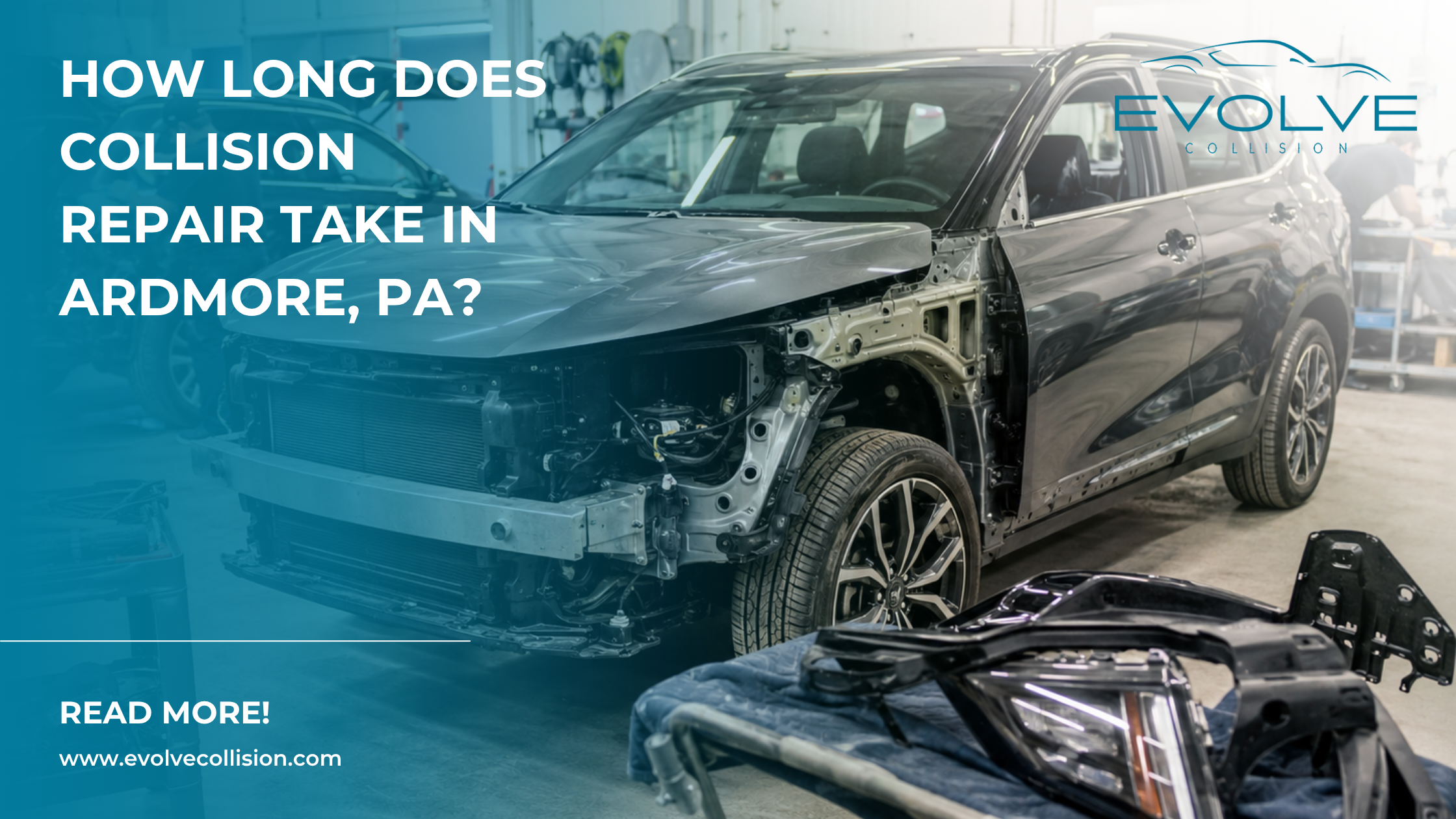
How Long Does Collision Repair Take in Ardmore, PA?

SUMMARY
- There is no single timeline for collision repair because every accident and vehicle is different.
- As a general reference, Evolve Collision Centers notes that minor repairs may take roughly 2–5 days, while moderate to major repairs may require 1–3 weeks, depending on damage and parts availability.
- Repair time can increase when technicians discover hidden damage after disassembly.
- Parts availability, insurance approvals, structural repairs, refinishing, OEM procedures, diagnostic scanning, and ADAS calibration can all affect completion time.
- An initial estimate is exactly that: an estimate. The timeline may change once technicians can fully inspect concealed areas.
- Rushing repairs can create problems if required procedures or quality-control steps are skipped.
- Clear communication from the repair facility helps drivers understand delays and changes to the expected completion date.
- Evolve Collision Centers, located at 2560 Haverford Rd, Ardmore, PA 19003, United States, provides collision repair for Ardmore and surrounding Main Line communities.
One of the first questions drivers ask after an accident is, “How long will it take to get my car back?”
It is understandable. Being without your vehicle can interfere with commuting, school schedules, appointments, family responsibilities, and everyday errands.
Unfortunately, collision repair does not follow a universal timetable.
A vehicle with a damaged bumper and minor paint work may move through the repair process relatively quickly. Another vehicle that looks similarly damaged from the outside could have broken mounting points, structural concerns, sensor damage, or parts that must be ordered before repairs can continue.
For drivers seeking collision repair in Ardmore, PA, understanding what controls the timeline can make the process less frustrating. Evolve Collision Centers explains that repair times vary according to damage severity, parts availability, and manufacturer repair requirements. After inspection, the facility provides an estimated timeline and keeps customers updated as work progresses.
How Long Does Collision Repair Usually Take?
There is no exact number of days that applies to every vehicle.
As a general guideline, Evolve Collision Centers has previously identified approximate timelines of:
- Minor repairs: 2–5 days
- Moderate to major repairs: 1–3 weeks
These are general ranges rather than guaranteed completion times.
A better way to think about collision repair time is to ask:
What operations does this particular vehicle require before it can be properly returned to the customer?
The answer may involve:
- Damage assessment
- Insurance authorization
- Disassembly
- OEM repair research
- Parts ordering
- Structural or body repair
- Refinishing
- Reassembly
- Diagnostic scanning
- ADAS calibration when required
- Final inspection
The number and complexity of these steps determine the actual timeline.
What Factors Affect Collision Repair Time?
Several variables can influence how long your vehicle remains at an auto body shop.
Common factors include:
- Severity of collision damage
- Hidden damage
- Parts availability
- Insurance approvals
- Supplemental estimates
- Structural repairs
- Vehicle make and model
- OEM repair procedures
- Paint and refinishing requirements
- Diagnostic scanning
- ADAS calibration
- Final quality inspections
A relatively straightforward repair involving one exterior panel will generally require less work than an accident affecting several panels, structural components, electronics, and safety systems.
This is why comparing your repair timeline with a friend’s previous collision is rarely useful.
The vehicles and damage may be completely different.
Why Is the Initial Estimate Only the Beginning?
The first inspection gives technicians an important starting point.
During the initial assessment, technicians may document:
- Visible body damage
- Damaged exterior components
- Paint damage
- Panel alignment
- Obvious structural concerns
- Warning lights
- Potential sensor involvement
However, technicians cannot necessarily see everything while the vehicle remains assembled.
A bumper cover may conceal damaged reinforcement. A bent fender may hide damaged mounting points. Exterior impact damage may also extend into inner body structures.
Evolve Collision Centers describes its initial process as including visual assessment, photo documentation, insurance review when applicable, a preliminary cost breakdown, and discussion of the anticipated repair timeline.
The initial estimate therefore establishes the preliminary repair plan rather than guaranteeing that no additional damage will be discovered.
Why Does Disassembly Affect the Repair Timeline?
Disassembly allows technicians to examine areas that were inaccessible during the initial inspection.
Depending on the accident, they may remove:
- Bumper covers
- Exterior trim
- Headlights
- Damaged panels
- Interior components
- Other parts obstructing the impact area
This can reveal:
- Bent brackets
- Cracked mounting points
- Damaged reinforcement
- Structural distortion
- Wiring problems
- Sensor damage
- Additional damaged components
Evolve Collision Centers describes this stage as disassembly and blueprinting, noting that concealed issues such as sensor misalignment, frame distortion, broken brackets, and damaged mounting points may be identified at this stage.
Finding hidden damage can extend the repair timeline, but identifying it is essential to developing a complete repair plan.
What Is Collision Repair Blueprinting?
Blueprinting is the process of developing a detailed repair plan after thoroughly evaluating the vehicle.
Instead of beginning repairs immediately and discovering requirements one at a time, technicians attempt to identify:
- Everything damaged
- Required replacement parts
- Required repair operations
- OEM procedures
- Necessary materials
- Diagnostic requirements
- Calibration requirements
A detailed blueprint can make the later repair stages more organized.
It also helps the shop provide a more realistic completion estimate once the true scope of damage becomes clearer.
Evolve Collision Centers specifically notes that thorough blueprinting supports accurate parts ordering, realistic repair timelines, and communication with insurance companies.
How Can Hidden Damage Delay Collision Repair?
Hidden damage is one of the biggest reasons an initial repair timeline can change.
Imagine a rear bumper with a visible crack.
After removal, technicians might discover:
- Broken absorber
- Bent reinforcement
- Damaged sensor bracket
- Torn wiring
- Damaged body mounting point
Those components were not necessarily visible during the initial exterior inspection.
The repair facility may now need to:
- Document the additional damage
- Update the repair plan
- Prepare a supplement
- Coordinate with insurance when applicable
- Order additional parts
- Perform additional repairs
This adds time, but ignoring concealed damage simply to preserve the original completion date would not be an appropriate solution.
How Do Parts Delays Affect Collision Repair?
Parts availability can significantly influence repair time.
A vehicle cannot always proceed to the next stage if a required component has not arrived.
Potential delays can involve:
- Backordered parts
- Shipping delays
- Incorrect parts
- Damaged parts received from suppliers
- Model-specific components
- Electronic modules
- Specialized trim
- Structural components
Newer, luxury, imported, electric, or recently redesigned vehicles may sometimes require components that are less readily available.
Even a relatively small component can interrupt progress if technicians need it before completing reassembly or another dependent operation.
This is why parts availability is one of the factors Evolve Collision Centers specifically identifies when explaining how long collision and auto body repairs can take.
Can Insurance Approval Delay Repairs?
It can.
When an insurance claim is involved, the repair process may require communication between:
- Customer
- Repair facility
- Insurance adjuster
- Parts suppliers
If additional collision damage is discovered after disassembly, the shop may prepare a supplemental estimate documenting repairs that were not included in the original estimate.
The insurer may need to review that information before the claim progresses.
Evolve Collision Centers states that it works with major insurance carriers and helps customers coordinate the claims process while maintaining repairs according to manufacturer procedures and documented repair standards.
Clear documentation can help make these conversations more organized, but the shop cannot necessarily control how quickly every outside party responds.
What Is a Supplemental Estimate?
A supplement is an addition or revision to the original repair estimate.
It commonly becomes necessary when technicians discover damage that could not be confirmed during the initial inspection.
A supplement might include:
- Additional replacement parts
- Additional labor
- Structural operations
- Sensor components
- Diagnostic procedures
- Calibration requirements
- Additional refinishing
Supplements are relatively understandable in collision repair because exterior components can conceal the true extent of impact damage.
A supplement does not automatically mean the original estimator overlooked something obvious.
Sometimes the vehicle physically needed to be disassembled before the additional damage could be verified.
Why Do Structural Repairs Take Longer?
Structural repairs can require additional planning, measurements, equipment, and manufacturer-specific procedures.
Modern vehicles contain engineered structures designed to manage collision forces.
Damage may involve:
- Frame rails
- Rocker structures
- Pillars
- Floor sections
- Structural reinforcements
- Crush zones
Evolve Collision Centers emphasizes that modern collision repair involves restoring structural alignment and engineered load paths rather than simply correcting exterior appearance.
Technicians may need to:
- Measure the structure
- Research OEM requirements
- Remove damaged components
- Complete approved straightening when permitted
- Replace structural sections when required
- Perform manufacturer-specified joining procedures
- Restore corrosion protection
These operations naturally take longer than correcting a small cosmetic dent.
Why Can OEM Procedures Add Time to a Repair?
Modern vehicles cannot always be repaired using one universal approach.
Manufacturers may specify:
- Which components can be repaired
- Which components must be replaced
- Where sectioning is permitted
- What welding method must be used
- Whether heat is allowed
- Which adhesives are required
- How corrosion protection must be restored
- Whether scanning or calibration is required
Researching and following these procedures can require additional time.
However, skipping required steps simply to complete a repair faster is not an appropriate tradeoff.
Evolve Collision Centers states that it follows OEM repair procedures as standard practice and maintains OEM certification alongside I-CAR Gold Class recognition.
How Long Does Auto Body Repair Take?
Auto body repair timelines depend heavily on what is being repaired.
Examples can include:
Minor exterior damage
- Small dents
- Scratches
- Limited paint damage
These may require fewer operations.
Moderate body damage
- Multiple damaged panels
- Door or fender replacement
- Bumper replacement
- More extensive refinishing
These typically require additional disassembly, parts, paint preparation, and reassembly.
Major collision damage
- Structural repairs
- Multiple replacement components
- Extensive disassembly
- Electronic safety-system involvement
These can require considerably more time.
Evolve Collision Centers specifically states that auto body repair time depends on damage extent, parts availability, and manufacturer requirements.
How Does Paint and Refinishing Affect the Timeline?
Professional refinishing involves more than spraying color onto a replacement panel.
Depending on the repair, technicians may need to perform:
- Surface preparation
- Sanding
- Primer application
- Color matching
- Spray-out testing
- Base coat application
- Clear coat application
- Curing
- Polishing
- Final inspection
Some repairs also require blending into adjacent panels to create a natural color transition.
The complexity increases with:
- Metallic colors
- Pearl finishes
- Multi-stage paint
- Difficult color variants
Evolve Collision Centers offers dedicated paint work as part of its auto body repair capabilities.
The time spent preparing and verifying the finish is part of producing a professional result rather than an unnecessary delay.
Does ADAS Calibration Make Collision Repair Take Longer?
It can.
Advanced Driver Assistance Systems can include:
- Forward-facing cameras
- Radar sensors
- Blind-spot monitoring
- Parking sensors
- Lane assistance
- Adaptive cruise control
Depending on the vehicle and repair, manufacturer procedures may require calibration after certain components are removed, replaced, repositioned, or repaired.
Evolve Collision Centers explains that repairs affecting sensor positioning, alignment, or suspension geometry can require calibration. The facility coordinates required ADAS calibrations either internally or through specialized partners depending on manufacturer requirements.
Drivers can review Evolve’s scanning and calibration services for more information.
Calibration adds another operation to the process, but it should not be skipped merely to shorten the completion time.
Why Are Pre- and Post-Repair Scans Important?
Modern vehicles contain interconnected electronic systems that may store diagnostic information following a collision.
A pre-repair scan can help identify issues that need to be considered during repair planning.
A post-repair scan may help technicians evaluate applicable systems after repairs.
Evolve Collision Centers notes that many newer vehicles require diagnostic scanning and incorporates scanning into repairs when manufacturer requirements or the repair situation call for it.
This means collision repair time increasingly includes electronic diagnostics in addition to traditional body and paint work.
Can Glass Damage Extend the Repair Timeline?
Yes.
A collision may damage:
- Windshield
- Door glass
- Quarter glass
- Back glass
Replacement glass may need to be ordered, installed, and allowed to meet applicable adhesive requirements before the vehicle progresses.
On vehicles equipped with windshield-mounted cameras, glass replacement can also be associated with ADAS calibration requirements.
Evolve Collision Centers provides professional glass work as part of its repair services.
The exact timeline depends on glass availability, installation requirements, and the technology installed on the vehicle.
Do Electric Vehicles Sometimes Take Longer to Repair?
They can, depending on the damage and vehicle.
Electric vehicles may introduce additional considerations involving:
- High-voltage systems
- Battery protection
- Specialized structural materials
- Manufacturer-specific procedures
- Specialized parts
- Electronic diagnostics
This does not mean every EV repair automatically takes longer than every gasoline-powered vehicle repair.
The timeline depends on the actual damage.
However, specialized procedures and parts availability can influence the schedule, which is why a repair facility should evaluate the specific year, make, model, and collision rather than provide a generic promise.
Can a Repair Shop Guarantee an Exact Completion Date?
Usually, a responsible collision repair facility provides an estimated completion date, not an unconditional guarantee.
Variables outside the shop’s direct control can include:
- Parts backorders
- Shipping
- Additional hidden damage
- Insurance approvals
- Manufacturer-specific requirements
Evolve Collision Centers states that it provides an estimated completion time after the initial assessment and updates customers throughout the process.
A timeline becoming longer does not automatically mean the repair facility is working slowly.
The reason for the change matters.
What Can Vehicle Owners Do to Help Prevent Unnecessary Delays?
Drivers cannot control every part of the process, but they can help keep communication moving.
Consider:
- Report the claim promptly when using insurance
- Provide accurate contact information
- Respond to authorization requests
- Provide insurance information early
- Remove personal belongings before drop-off
- Ask about parts availability
- Discuss rental transportation early
- Keep communication open with the repair facility
If you will need temporary transportation, address it before dropping off the vehicle rather than after repairs have already begun.
Being organized does not guarantee a faster repair, but it can prevent avoidable administrative delays.
Should You Choose the Shop That Promises the Fastest Repair?
Not necessarily.
Speed matters, especially when you depend on your vehicle every day.
But the shortest promised timeline should not automatically determine where your vehicle is repaired.
A more useful set of questions includes:
- Does the shop follow OEM procedures?
- Does it have appropriate technician training?
- Does it perform necessary diagnostic scanning?
- Can it coordinate required ADAS calibration?
- How does it handle hidden damage?
- How will it communicate delays?
- What quality-control process happens before delivery?
Evolve Collision Centers is an I-CAR Gold Class facility and maintains OEM certification reflecting manufacturer training and equipment requirements.
Those qualifications can be more meaningful than a promise to finish a complicated repair unusually quickly.
Why Shouldn’t Collision Repair Be Rushed?
Drivers understandably want their vehicles returned quickly.
However, rushing can become problematic if it means compromising necessary steps.
A complete repair may need time for:
- Damage analysis
- OEM research
- Structural work
- Parts installation
- Paint preparation
- Refinishing
- Curing
- Diagnostics
- Calibration
- Quality control
The goal is not simply to make the vehicle look repaired as quickly as possible.
It is to complete the required repair operations and verify the work before returning the vehicle.
For modern vehicles with complex structures and electronic systems, that distinction is increasingly important.
What Happens During the Final Quality Inspection?
Before returning the vehicle, the repair facility should evaluate the completed work.
Depending on the repair, technicians may inspect:
- Panel alignment
- Paint appearance
- Exterior trim
- Door operation
- Hood and trunk operation
- Lighting
- Dashboard warning indicators
- Diagnostic results
- ADAS-related procedures
- Overall repair quality
If technicians identify an issue during final inspection, correcting it may add time.
That can be frustrating when the customer is expecting pickup that day, but final quality control exists specifically to identify concerns before the vehicle is returned.
How Should a Collision Shop Communicate Delays?
Good communication cannot eliminate every delay, but it can make the process easier to understand.
Customers should ideally know:
- What stage the repair is in
- Whether parts have arrived
- Whether additional damage was discovered
- Whether insurance approval is pending
- Whether the expected completion date changed
- What remains before delivery
Evolve Collision Centers emphasizes structured repairs and clear communication, stating that customers receive updates as repairs progress.
When something changes, ask why.
A clear explanation is more useful than focusing only on the number of additional days.
What Should You Ask When Dropping Off Your Vehicle?
Before leaving your vehicle for collision repair, consider asking:
- What is the estimated repair timeline?
- Has the vehicle been fully disassembled yet?
- Are required parts available?
- Could hidden damage change the timeline?
- How are supplements handled?
- Will OEM procedures be researched?
- Does my vehicle require diagnostic scanning?
- Could ADAS calibration be necessary?
- How often will I receive updates?
- Who should I contact with questions?
These questions establish realistic expectations from the beginning.
They also help you understand which stages could affect the estimated completion date.
Frequently Asked Questions
How long does collision repair usually take in Ardmore, PA?
It depends on damage severity, parts availability, manufacturer requirements, and additional procedures. Evolve Collision Centers provides a general reference of approximately 2–5 days for minor repairs and 1–3 weeks for moderate to major repairs, although individual repairs can take more or less time.
Can collision repair take longer than originally estimated?
Yes. Hidden damage, parts delays, insurance supplements, additional OEM-required operations, or calibration needs can extend the original timeline.
Why does hidden damage delay repairs?
Some collision damage cannot be seen until bumpers, trim, panels, or other components are removed. Additional damage can require new parts, labor, documentation, and insurance review.
Can parts availability delay collision repair?
Yes. Parts availability is one of the factors Evolve Collision Centers specifically identifies as affecting repair time.
Does ADAS calibration add time to collision repair?
It can. When manufacturer procedures require calibration after collision-related repairs, the calibration must be incorporated into the overall repair process.
Should I choose the body shop promising the fastest repair?
Not based on speed alone. Consider OEM procedures, certifications, technician training, diagnostic capabilities, communication, and quality-control processes.
Will I know exactly when my vehicle will be finished?
A repair facility can provide an estimated completion date, but the timeline may change if additional damage, parts delays, or other requirements arise.
Where can I get collision repair in Ardmore, PA?
Evolve Collision Centers provides collision and auto body repair at 2560 Haverford Rd, Ardmore, PA 19003, United States, serving Ardmore and surrounding Main Line communities.
Need Collision Repair in Ardmore, PA? Start With a Thorough Damage Assessment
There is no universal answer to how long collision repair takes. A relatively minor repair may be completed within several days, while more complicated damage can require weeks depending on structural work, parts availability, insurance coordination, refinishing, OEM procedures, diagnostic scanning, and ADAS calibration.
The most useful timeline is one based on your specific vehicle and its complete repair plan, not a generic industry average.
If your vehicle has been involved in an accident, visit Evolve Collision Centers at 2560 Haverford Rd, Ardmore, PA 19003, United States. The team provides professional collision repair, auto body repair, paint work, and scanning and calibration for modern vehicles. After evaluating the damage, Evolve Collision Centers can establish an estimated repair timeline and keep you informed as the vehicle progresses through the repair process.