
Evolve Collision Centers
2560 Haverford Road
Ardmore, PA 19003
Email: info@evolvecollision.com
Phone: (267) 692-6699
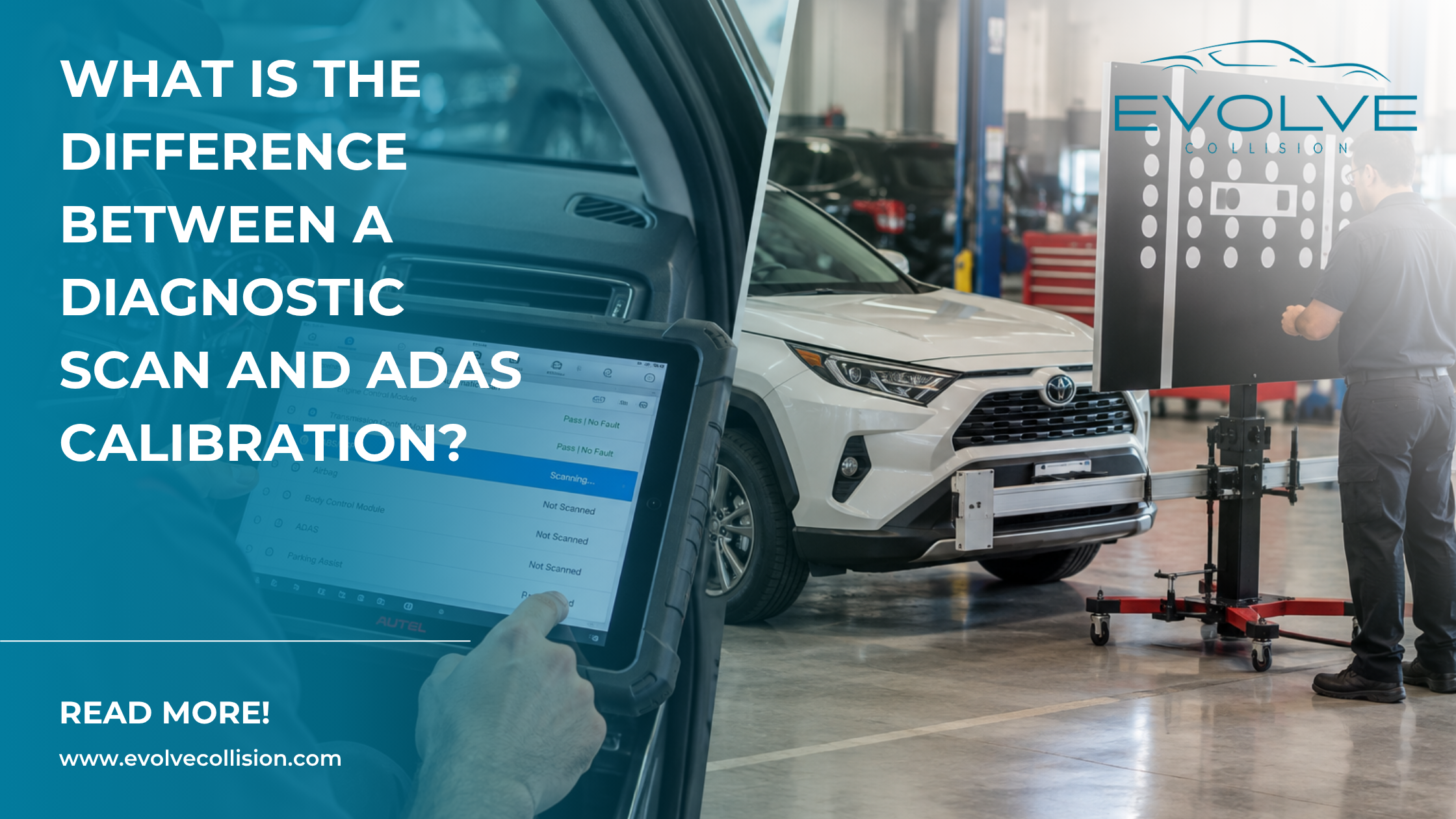
What Is the Difference Between a Diagnostic Scan and ADAS Calibration?

SUMMARY
- A diagnostic scan and ADAS calibration are two different procedures. One does not automatically replace the other.
- A diagnostic scan communicates with the vehicle’s electronic control modules and can identify information such as diagnostic trouble codes (DTCs) and systems reporting faults.
- ADAS calibration is a procedure used to establish or verify the proper operation or positioning of applicable cameras, radar sensors, and other driver-assistance components according to manufacturer requirements.
- A vehicle can require a diagnostic scan without requiring ADAS calibration. It can also require both procedures depending on the collision and repairs performed.
- Clearing a trouble code is not the same as calibrating a camera or radar sensor.
- Calibration requirements can be triggered by operations such as sensor replacement, windshield replacement, bumper work, alignment-related procedures, or removal and installation of certain components, depending on the vehicle manufacturer.
- ADAS calibration can be static, dynamic, or require a combination of procedures. The exact process varies by vehicle.
- Neither scanning nor calibration replaces physical collision damage analysis. A scan cannot repair a bent bracket, and calibration cannot correct a damaged suspension component or improperly repaired body structure.
- The correct procedures should be determined using the specific vehicle, installed equipment, collision damage, repairs performed, and manufacturer repair information.
- Ardmore drivers can have collision-related diagnostic and calibration needs evaluated at Evolve Collision Centers, 2560 Haverford Rd, Ardmore, PA 19003.
Diagnostic Scan vs. ADAS Calibration: What Is the Simple Difference?
The easiest way to understand the difference is this:
A diagnostic scan communicates with the vehicle’s electronic systems.
ADAS calibration performs a specific procedure involving applicable driver-assistance sensors or cameras.
They can be related.
But they are not interchangeable.
Modern collision repair can involve both because today’s vehicles contain numerous electronic systems alongside traditional mechanical and body components.
Understanding the difference can make a complicated repair estimate much easier to follow.
What Is a Diagnostic Scan?
A diagnostic scan uses compatible diagnostic equipment to communicate with electronic control modules in the vehicle.
Modern vehicles can contain modules controlling or monitoring systems involving:
- Engine
- Transmission
- Braking
- Airbags and restraints
- Steering
- Stability control
- Body electronics
- Cameras and sensors
- Driver-assistance features
Depending on the vehicle and diagnostic equipment, a scan can identify information stored by these systems.
One important example is a diagnostic trouble code, commonly called a DTC.
What Is a Diagnostic Trouble Code?
A DTC is information recorded by a vehicle control system when it detects certain conditions or faults.
For example, a scan might identify a code associated with:
- Disconnected component
- Communication problem
- Sensor-related fault
- Electrical issue
- System malfunction
A trouble code is a starting point for diagnosis.
It does not always tell the technician:
“Replace this exact part.”
The technician still needs to determine what caused the code.
What Is ADAS?
ADAS stands for Advanced Driver Assistance Systems.
Depending on the vehicle, these technologies can support features such as:
- Automatic emergency braking
- Forward collision warning
- Adaptive cruise control
- Lane departure warning
- Lane keeping assistance
- Blind spot monitoring
- Rear cross-traffic alert
- Parking assistance
The National Highway Traffic Safety Administration provides consumer information about many driver-assistance technologies available on modern vehicles.
ADAS features can rely on several types of components.
What Components Can ADAS Use?
Depending on the vehicle, an ADAS feature may use:
- Cameras
- Radar sensors
- Ultrasonic sensors
- Other electronic components
These components can be located around the:
- Windshield
- Grille
- Front bumper
- Rear bumper
- Side mirrors
- Other parts of the vehicle
Because collision repair can involve these same areas, ADAS procedures have become an important consideration during modern auto body repair.
What Is ADAS Calibration?
ADAS calibration is a procedure used when required to establish or verify the relationship of applicable cameras, radar sensors, or other components to the vehicle.
Calibration procedures are vehicle-specific.
Depending on the system, they may require:
- Specialized diagnostic equipment
- Calibration targets
- Precise measurements
- Vehicle positioning
- Specific shop conditions
- Driving under specified conditions
Evolve Collision Centers provides scanning and calibration for vehicles requiring these procedures during collision repair.
Why Are Scanning and Calibration Often Confused?
They frequently appear on the same collision repair estimate.
For example, a repair plan could include:
- Pre-repair diagnostic scan
- Body repair
- Replacement of damaged components
- Reassembly
- ADAS calibration
- Post-repair diagnostic scan
When drivers see several electronic procedures listed together, it can look as though they are all doing the same thing.
They are not.
Each can serve a different purpose in the repair process.
Step 1: Understand What a Pre-Repair Scan Does
A pre-repair scan can provide information about the vehicle’s electronic systems before repairs begin.
Depending on the vehicle, technicians may identify:
- Existing DTCs
- Collision-related system information
- Systems requiring further diagnosis
- Electronic concerns that need to be considered during repair planning
This can help technicians understand the vehicle before disassembly and repair.
Step 2: Understand What a Scan Cannot See
A diagnostic scanner communicates electronically.
It does not physically inspect the vehicle.
For example, a scan does not replace inspection for:
- Dented panels
- Bent brackets
- Broken bumper mounts
- Cracked components
- Wheel damage
- Suspension damage
- Incorrect panel gaps
- Structural changes
This is why a vehicle can have no relevant trouble code and still have physical collision damage.
Can a Diagnostic Scan Tell Whether the Frame Is Bent?
No.
A diagnostic scan is not a structural measurement tool.
If collision evidence suggests structural damage, technicians need the appropriate physical inspection or measurement procedures.
Electronic scanning and structural evaluation answer different questions.
Step 3: Understand What a Post-Repair Scan Does
A post-repair scan occurs after applicable repair operations.
It can help technicians evaluate the electronic systems after components have been:
- Repaired
- Replaced
- Disconnected
- Reconnected
Depending on the vehicle and repair, technicians can review remaining diagnostic information and investigate issues that still require attention.
Does a Post-Repair Scan Automatically Prove the Entire Vehicle Is Repaired Correctly?
No.
A scan is only one part of the repair process.
A post-repair scan does not independently verify:
- Body alignment
- Paint quality
- Wheel condition
- Mechanical repair quality
- Structural measurements
- Calibration of every applicable ADAS component
Each area requires its appropriate procedure.
Step 4: Understand What Calibration Does Differently
Calibration focuses on applicable ADAS components.
Suppose a windshield-mounted camera is involved in the repair.
The vehicle manufacturer may specify a calibration procedure after:
- Camera replacement
- Windshield replacement
- Certain related repairs
A diagnostic scan might communicate with the camera system.
But communicating with the system is not the same as completing its required calibration.
Step 5: Think of Scanning as Communication
A simple way to remember it is:
Scanning = communicating with vehicle control systems.
The diagnostic tool asks the vehicle’s modules for information.
Technicians then use that information as part of diagnosis and repair planning.
Step 6: Think of Calibration as Setup or Verification
Calibration is different.
A simple way to think about it is:
Calibration = completing the specified procedure so an applicable ADAS component is set up or verified according to the vehicle’s requirements.
That can involve much more than plugging in a scanner.
Step 7: Understand That Clearing Codes Is Not Calibration
This is one of the most important distinctions.
A technician may be able to clear a DTC after a problem has been addressed.
That does not automatically mean:
- Camera was calibrated
- Radar was calibrated
- Required ADAS procedure was completed
Code clearing and calibration are separate actions.
Step 8: Understand That Calibration Can Require Diagnostic Equipment
There is some overlap in the tools involved.
ADAS calibration can require diagnostic equipment to:
- Initiate procedures
- Communicate with systems
- Monitor calibration progress
But that does not make scanning and calibration the same thing.
Think of the diagnostic equipment as a tool that can be used for multiple different procedures.
Step 9: Know When a Collision May Lead to Diagnostic Scanning
Scanning can become relevant when collision repair involves modern electronically controlled systems.
The exact scanning requirements vary by manufacturer and vehicle.
The I-CAR Repairability Technical Support Portal provides collision professionals with resources for researching vehicle-specific scanning, calibration, and repair information.
Technicians should research the procedures that apply rather than assuming every vehicle follows the same process.
Step 10: Know When ADAS Calibration May Be Required
Calibration can be triggered by specific repairs or component changes.
Depending on the manufacturer and vehicle, examples can include:
- Camera replacement
- Radar sensor replacement
- Sensor removal and installation
- Windshield replacement
- Bumper-related repairs
- Mirror replacement
- Alignment-related procedures
- Body repairs affecting sensor mounting areas
This is not a universal trigger list.
The manufacturer’s procedures for the specific vehicle determine what is required.
Does Every Collision Require ADAS Calibration?
No.
Some vehicles do not have applicable ADAS equipment.
Others may have ADAS, but the collision and repair do not trigger calibration.
The repair facility should identify:
- Installed systems
- Collision location
- Components affected
- Repairs performed
- Manufacturer requirements
before determining whether calibration is necessary.
Does Every Collision Require a Diagnostic Scan?
Scanning requirements also vary by vehicle and manufacturer.
Modern vehicles contain many electronic systems, so diagnostic scanning has become increasingly relevant to collision repair.
But the repair facility should still determine the appropriate procedures for the specific vehicle rather than relying on a blanket statement.
Step 11: Consider a Minor Front-Bumper Collision
Imagine your vehicle receives a minor front impact.
Visible damage includes:
- Scratched bumper
- Small dent
Technicians identify a radar sensor behind the affected area.
The repair process may need to determine:
- Was the radar affected?
- Was its bracket damaged?
- Does the bumper repair have restrictions?
- Does the sensor need removal?
- Is calibration required afterward?
A diagnostic scan can provide electronic information.
It cannot answer every physical repair question.
Step 12: Consider a Rear-Bumper Collision
A rear bumper can contain:
- Parking sensors
- Radar sensors
- Wiring
Depending on the vehicle, those systems may support:
- Parking assistance
- Blind spot monitoring
- Rear cross-traffic alert
After repair, scanning may be appropriate.
Calibration may also be required if a particular component or procedure triggers it.
Again, one procedure does not automatically replace the other.
Step 13: Consider Windshield Replacement
Windshield replacement provides another useful example.
Many newer vehicles have a forward-facing camera mounted near the windshield.
If collision damage requires glass work and windshield replacement, manufacturer procedures may specify camera calibration.
A scan may communicate with the camera system.
But the scan itself does not substitute for a required camera calibration.
Step 14: Consider a Damaged Side Mirror
Some side mirrors contain:
- Cameras
- Blind spot indicators
- Other electronics
If the mirror is damaged or replaced, technicians need to identify what equipment is present.
Depending on the system, the repair could involve:
- Diagnostic scanning
- Calibration
- Both
- Neither
The applicable manufacturer information determines the answer.
Step 15: Consider a Wheel-Area Collision
Suppose a collision damages a front wheel.
The repair may involve:
- Wheel
- Tire
- Suspension
- Steering
- Alignment
Certain ADAS procedures can have vehicle-geometry prerequisites.
But calibration cannot repair physical suspension damage.
The correct sequence may require technicians to address the mechanical condition before performing applicable calibration procedures.
Step 16: Understand Why Alignment and Calibration Are Different
Wheel alignment adjusts or verifies wheel geometry.
ADAS calibration deals with applicable cameras, radar sensors, or other driver-assistance components.
They are separate procedures.
However, they can sometimes be related because certain calibration procedures require specified vehicle geometry or alignment conditions.
Step 17: Understand Static Calibration
Some ADAS components use a static calibration procedure.
This can require the vehicle to remain stationary while technicians position equipment or targets according to manufacturer measurements.
Requirements can include:
- Vehicle positioning
- Target positioning
- Specific distances
- Floor conditions
- Tire pressures
- Other setup conditions
The procedure varies by vehicle.
Step 18: Understand Dynamic Calibration
Some systems use dynamic calibration.
This may require driving the vehicle under manufacturer-specified conditions while diagnostic equipment communicates with the system.
Requirements can potentially include:
- Vehicle speed
- Road type
- Lane markings
- Distance
- Weather or visibility conditions
A normal road test is not automatically the same as a dynamic calibration.
Step 19: Understand Combined Calibration
Some vehicles or systems can require both:
- Static procedure
- Dynamic procedure
Technicians should follow the specific procedure rather than choosing whichever method is more convenient.
Step 20: Understand Why the Calibration Environment Matters
ADAS components can be sensitive to setup conditions.
Depending on the procedure, technicians may need to control or verify:
- Floor level
- Target placement
- Vehicle position
- Tire pressure
- Vehicle load
- Lighting
- Surrounding objects
These requirements help explain why calibration is a specialized operation.
Step 21: Understand Why Sensor Brackets Matter
A camera or radar sensor needs a correct physical mounting position.
A collision can potentially damage:
- Bracket
- Mount
- Body component supporting the bracket
Even if the sensor itself appears intact, its position may have changed.
The physical mounting issue must be addressed before applicable calibration is completed.
Can Calibration Fix a Bent Sensor Bracket?
No.
Calibration is not a substitute for body repair.
If the bracket or mounting area is damaged, it needs to be repaired or replaced according to the applicable procedure.
Then the sensor can be installed and calibrated when required.
Step 22: Understand Why Bumper Repair Can Affect the Process
Some radar sensors operate through or near bumper areas.
That means bumper:
- Repair
- Replacement
- Removal
- Refinishing
can potentially affect ADAS procedures depending on the vehicle.
Evolve Collision Centers provides professional paint work as part of collision repair when damaged exterior components require refinishing.
When an ADAS sensor is involved, technicians should also account for any manufacturer restrictions related to the repair area.
Step 23: Understand Why OEM Information Matters
There is no single ADAS procedure for every vehicle.
Manufacturers can differ on:
- When scanning is required
- When calibration is required
- Which components trigger calibration
- Which calibration method applies
- Setup conditions
That is why vehicle-specific repair research matters.
Drivers can also review Evolve Collision Centers’ information about its OEM certifications and manufacturer-focused repair capabilities.
Step 24: Ask Why a Diagnostic Scan Appears on Your Estimate
If you see a scan on the estimate, ask:
“What is this scan being used for?”
The answer may involve:
- Pre-repair evaluation
- Post-repair evaluation
- Diagnostic investigation
This helps you understand where the procedure fits into the repair.
Step 25: Ask Why Calibration Appears on Your Estimate
If calibration appears separately, ask:
- Which system is being calibrated?
- Which sensor or camera is involved?
- What repair triggered the procedure?
- Is it static, dynamic, or both?
- What manufacturer requirement applies?
These are reasonable questions.
A useful explanation should connect the calibration to your actual vehicle and repair.
Step 26: Do Not Assume Two Electronic Operations Are Duplicate Charges
A scan and calibration can appear as separate operations because they perform different functions.
For example:
Pre-Repair
Diagnostic scan
During Repair
Camera or radar component repaired, removed, or replaced
After Repair
ADAS calibration
Final Electronic Check
Post-repair scan
Seeing several electronic procedures does not automatically mean the same work is being charged multiple times.
Ask what each operation does.
Step 27: Understand Why a Scan Can Find Unrelated Codes
A modern vehicle can store diagnostic information that may not necessarily have been caused by the current collision.
Technicians still need to determine:
- What the code means
- Whether it is collision-related
- Whether further diagnosis is needed
A scan result should be interpreted rather than assuming every stored code resulted from the accident.
Step 28: Understand Why a Collision May Not Create a Code
Physical damage does not always produce a diagnostic trouble code.
For example:
- Bent bracket
- Damaged body panel
- Changed panel gap
may not necessarily cause an electronic module to store a code.
That is why scanning cannot replace physical inspection.
Step 29: Understand Why No Codes Does Not Automatically Mean No Calibration
This distinction is particularly important.
A scan could potentially show no relevant DTCs while the manufacturer still requires calibration because a particular:
- Camera
- Sensor
- Windshield
- Bracket
- Related component
was removed or replaced.
Calibration requirements and DTCs answer different questions.
Step 30: Understand Why Calibration Does Not Replace the Post-Repair Scan
The reverse is also true.
Completing an ADAS calibration does not necessarily replace other diagnostic procedures required after collision repair.
A vehicle may need both.
Step 31: Keep the Documentation
When scanning or calibration is performed, ask what documentation is available.
Depending on the vehicle, equipment, and procedure, documentation can include information about:
- Vehicle identification
- Diagnostic scan
- DTCs
- Calibration procedure
- Calibration results
Keep applicable records with your collision repair documents.
Step 32: Pay Attention to the Vehicle After Repair
After getting the vehicle back, watch for:
- Warning lights
- ADAS unavailable messages
- Camera problems
- Parking assistance concerns
- Blind spot system concerns
- Driver-assistance features behaving differently
If you notice a problem, contact the repair facility.
Do not attempt to reposition cameras or radar sensors yourself.
Step 33: Remember That Electronics Are Only Part of the Repair
A modern collision repair can include:
- Body repair
- Structural evaluation
- Mechanical inspection
- Glass work
- Refinishing
- Diagnostic scanning
- Calibration
Each operation addresses a different part of the vehicle.
A scan cannot replace body repair.
Body repair cannot replace required calibration.
Calibration cannot replace mechanical repair.
The complete repair plan should bring these procedures together when they apply.
Diagnostic Scan vs. ADAS Calibration at a Glance
| Procedure | Diagnostic Scan | ADAS Calibration |
| Main purpose | Communicates with vehicle electronic modules | Performs specified setup or verification for applicable ADAS components |
| Can retrieve DTCs? | Yes, when supported | Not its primary purpose |
| Works with cameras/radar? | Can communicate with applicable systems | Yes, when those components require calibration |
| Fixes physical body damage? | No | No |
| Same as clearing codes? | No | No |
| Always required after every collision? | Requirements vary | No |
| Vehicle-specific? | Yes | Yes |
| Can both be required? | Yes | Yes |
Frequently Asked Questions
Is a diagnostic scan the same as ADAS calibration?
No. A diagnostic scan communicates with vehicle electronic systems and can retrieve information such as diagnostic trouble codes. ADAS calibration is a separate procedure for applicable cameras, radar sensors, or other driver-assistance components.
Can my vehicle need both scanning and calibration after a collision?
Yes. Depending on the vehicle and repair, a collision repair plan can include diagnostic scanning as well as one or more ADAS calibration procedures.
Does clearing a trouble code calibrate an ADAS sensor?
No. Clearing diagnostic information and completing an ADAS calibration are different procedures.
Does every collision require ADAS calibration?
No. Calibration depends on the vehicle, installed systems, damaged components, repairs performed, and manufacturer procedures.
Can a scan determine whether a radar bracket is bent?
No. A diagnostic scan does not replace physical inspection. Brackets, mounts, body components, wheels, and suspension still need appropriate physical evaluation.
Why might windshield replacement require calibration?
Many modern vehicles have forward-facing cameras near the windshield. Depending on the vehicle, windshield replacement can trigger a manufacturer-specified camera calibration procedure.
Why are a pre-scan and post-scan both listed on a repair estimate?
They can serve different purposes. A pre-repair scan can help identify electronic-system information before repairs, while a post-repair scan can help evaluate the vehicle’s systems after applicable repair work has been completed.
Where can Ardmore drivers get diagnostic scanning and ADAS calibration after a collision?
Drivers can contact Evolve Collision Centers at 2560 Haverford Rd, Ardmore, PA 19003 for collision repair, diagnostic scanning, and ADAS calibration services.
Scanning Tells Technicians About Electronic Systems. Calibration Is a Separate Procedure.
It is easy to see the words scan and calibration on a collision estimate and assume they mean the same thing.
They do not.
A diagnostic scan communicates with the vehicle’s electronic control systems.
ADAS calibration addresses applicable cameras, radar sensors, and other driver-assistance components when a calibration procedure is required.
Depending on the collision, your vehicle might need:
- Scanning only
- Calibration only in a specific context
- Both scanning and calibration
- Additional physical, mechanical, body, or glass repair
The correct answer should come from the vehicle itself and the manufacturer’s procedures rather than a blanket rule.
Evolve Collision Centers provides collision repair, auto body repair, glass work, paint work, and scanning and calibration for modern vehicles following an accident.
Ardmore drivers can contact Evolve Collision Centers to have their vehicle evaluated and determine which diagnostic, calibration, and collision repair procedures apply.
Evolve Collision Centers
2560 Haverford Rd Ardmore, PA 19003, United States